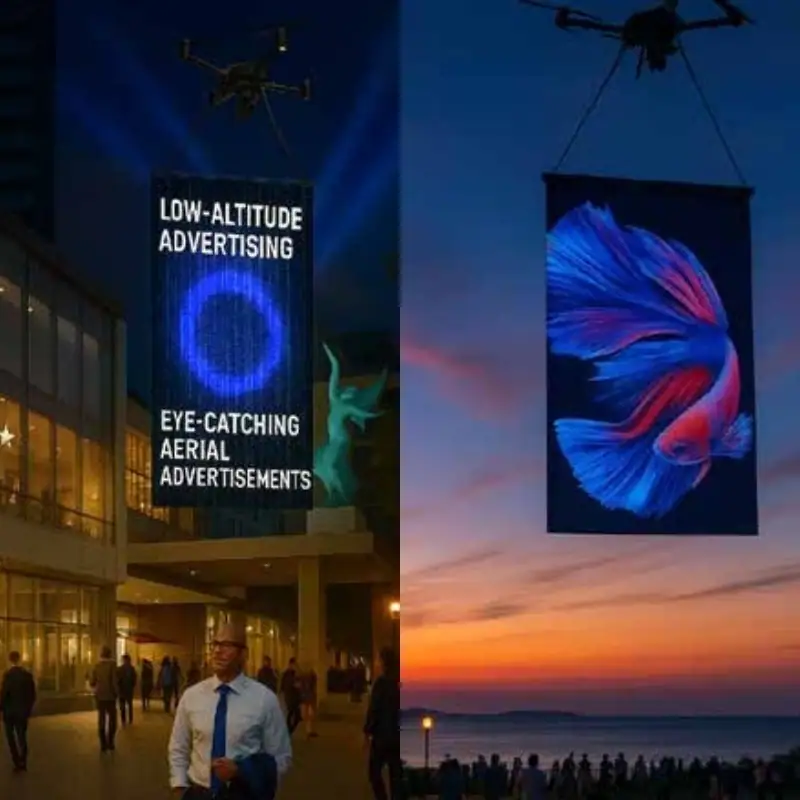
A flying screen is an LED display built to be suspended in the air — usually a lightweight mesh panel carried by drones or hung from rigging — so an audience sees moving images above a stage, a crowd or a skyline. Suppliers also call it a flying LED mesh screen, drone LED screen or aerial display. Whatever the label, the purchasing problem is the same: the display, the suspension method and the show workflow have to agree with each other before a single panel is built.
Most RFQs in this category fail for ordinary reasons. A buyer specifies a pixel pitch and a size, receives a quotation, and only later discovers that the power plan, the attachment points, the spare-parts package or the documentation for the destination market was never discussed. The checklist below is written for distributors, installers, event producers and private-label buyers who want the first quotation to be comparable with the second and the third.
1. Define the flying method before the display
Write down how the screen will be held in the air before you discuss pixels: drone-suspended, hung from truss or crane, or a combination used in different scenes. One Smart Lighting’s site describes hanging and drone-suspended LED mesh screens used as flying displays for events, exhibitions and aerial advertising (drone LED screen range). The flying method decides which mechanical questions matter — attachment hardware, sling design, battery placement and the split between screen weight and drone payload.
If drones are involved, bring the drone operator into the conversation at RFQ stage. The operator needs the interface drawing early. The screen supplier and the operator should confirm compatibility in writing before production, because changing a frame after it has been built is expensive and slow.
2. Specify size, aspect ratio and pixel pitch together
Size on its own is not a specification. Ask for module dimensions, module count per screen, finished aspect ratio, and the pixel pitches actually available in that format. The EvledEV Flying Magic Carpet Screen page, for example, lists P20 and P25 pitch options for the same product family (Flying Magic Carpet Screen). A finer pitch is not automatically the better choice for every show: it changes the pixel count, the processing load and often the cost. Ask the supplier to recommend a pitch from your viewing distance and content type, and to state the viewing distance assumed in that recommendation.
Also agree how the finished screen will be measured. A 4 by 8 metre screen quoted by one supplier may include a frame that another supplier excludes. Put length, height and the measurement basis — lit area or finished frame — into the RFQ table so quotations line up.
3. Pin down the power architecture
Flying screens are generally battery-powered or fed from a tether. The Magic Carpet page lists a 5V input and battery power for that model. For an RFQ, ask how many battery sets ship per screen, what runtime the supplier guarantees per set at a stated brightness, how batteries are charged and swapped during a multi-day event, and whether the operator can see remaining charge. Runtime figures must come from the supplier in writing; do not estimate them from battery capacity. Ask what happens at low-voltage cutoff during a show and whether the control system can fail over without blanking the display.
4. Ask how brightness was measured
The same product page lists brightness of 1500–1800 nits. A nits figure is only useful when you know the measurement condition: drive level, white balance, whether it is typical or maximum, and whether it was measured on a full screen or a single module. Ask for the method and for sample footage shot at dusk and at night. For twilight or daylight events, ask the supplier to state plainly whether the product is intended for those conditions. Do not assume that a quoted brightness means sunlight visibility.
5. Weather protection, wind and climate
The Magic Carpet page lists IP65 screen protection. Ask what that rating covers in the supplier’s testing — dust, spray, rain at an angle — and what it does not cover, such as immersion or prolonged driving rain. Then ask for the wind limit: the maximum operating wind speed for the flying configuration, the evidence behind it, and the procedure for grounding or landing the screen when conditions change. A screen flown over the Arabian Gulf in August, on a North Sea coast in winter or during a Southeast Asian monsoon season faces different heat, humidity and salt exposure. State the destination climate in the RFQ and ask for the matching operating temperature range, storage advice and any derating for high ambient temperature.
6. Weight, attachment points and load data
Request the weight of the complete flying assembly — modules, frame, cabling, batteries and controllers — not only the LED panels. Ask for a dimensioned drawing that shows attachment points, the load at each point, sling length and the hardware included. If the operator’s drones have a published payload limit, compare it with the assembly weight plus a safety margin agreed with the operator. Ask whether the frame is supplied assembled or in sections, and how long assembly takes on site with the crew you actually have.
7. Control, media and redundancy
Ask what resolution and media formats the screen accepts, which playback software runs the content, and whether the supplier provides a media server or expects you to integrate your own. For advertising and sponsorship, confirm how playlists, scheduling and last-minute content changes are handled on site. Ask about redundancy: a second playback path, spare data cabling and a written recovery procedure if the signal drops mid-show. For irregular shapes or multi-panel builds, agree who prepares the content mapping and whether a template file is supplied with the order.
8. Documentation for the destination market
Safety evaluation is regional, not universal. UL Solutions describes evaluation considerations for line-voltage and low-voltage outdoor luminaires in the United States and Canada (UL outdoor lighting services), and separately describes safety testing and certification services for seasonal and decorative lighting (UL seasonal lighting services). Those notes apply to the U.S. and Canadian framework. Buyers shipping to the European Union, the United Kingdom, Australia, the Gulf states or other regions must confirm the applicable scheme for each destination with the supplier and, where needed, a local test house.
In the RFQ, list the destination countries and ask which test reports, declarations and marking documents the supplier can provide for the exact model and voltage variant being quoted. A certificate covering a different model, a different control gear or a different voltage is not evidence for your order. Ask for document numbers and the model references they cover, and check them before paying the deposit. A certification page on a supplier website describes a company portfolio, not necessarily the exact SKU you are buying. If the screen will be used in a public venue, the venue’s safety officer may ask for additional documentation; clarify that requirement early.
9. Warranty, spares and service
The Magic Carpet page lists a two-year warranty and a 20,000-hour lifespan for that model. Ask what the warranty covers in practice: LED modules, driver boards, batteries, cables and labour; whether it is replacement or repair; who pays freight; and how a claim is evidenced through photos, logs or returned parts. For a rental fleet or a touring show, negotiate a spares package — typically a percentage of modules, cables, receiving cards and batteries — and ask for the supplier’s recommended spares list. A quoted lifespan figure is not a promise about event hours; ask how it was derived and what conditions it assumes.
10. Acceptance testing and shipping
Before shipment, ask for a factory test video showing every module at full white, full red, full green and full blue, plus a dead-pixel count against an agreed limit. Put the acceptance criteria in the purchase order: maximum acceptable dead pixels per module, colour uniformity tolerance, brightness uniformity and the test pattern used. Ask how the screen is packed — flight cases, desiccant, module labels, spare fuses — and request the packing list and gross weight before booking freight. Confirm the HS code, country of origin and incoterm, because these affect landed cost and customs clearance and belong on the quotation rather than in a message after the container has sailed.
What to put in the first RFQ
- Flying method and the drone or rigging operator’s requirements
- Finished size, aspect ratio, measurement basis and pixel pitch
- Viewing distance and content type, with examples
- Event duration, number of shows and daily flight hours
- Destination city and climate, plus indoor or outdoor use
- Power preference and battery-swap plan
- Control platform, media formats and redundancy expectations
- Destination countries and required documentation
- Spares package and warranty terms
- Acceptance test criteria, packing and incoterm
FAQ
Is a flying screen the same as a drone light show?
No. A drone light show uses individual illuminated drones as pixels in the sky. A flying screen is a physical LED mesh display carried by drones or rigging. Some productions combine both, but the procurement questions differ: a light show is largely a fleet and choreography purchase, while a flying screen is a display purchase with mechanical and power interfaces.
What pixel pitch should I choose?
It depends on viewing distance, content and budget. The supplier should recommend a pitch and state the viewing distance assumed. The Magic Carpet family lists P20 and P25, but availability for your size, frame and controller must be confirmed in the quotation rather than assumed from the product page.
Can the screen fly in rain?
The Magic Carpet page lists IP65, but a rating alone does not define an operating policy. Ask for written guidance on rain, wind and temperature limits for the exact configuration, and follow the event risk assessment. IP65 should not be read as permission to fly in any weather.
Do I need certification for every country?
Market-access requirements are regional. Confirm the applicable scheme for each destination and ask for documents that reference the exact model. U.S. and Canadian outdoor lighting evaluation is described by UL Solutions; other regions apply their own frameworks, so a single certificate should not be treated as global approval.
How do I compare quotations from different suppliers?
Issue the same RFQ table to every supplier, require the same measurement basis and test criteria, and ask each one to list exclusions. A lower price often reflects a smaller spares package, a shorter warranty, no media server or documentation that does not cover your destination market. Compare the complete scope, not the headline screen price.
Where to start
If you are still choosing between a flying screen and a drone light show, define the audience sightline and the content first; the technology follows. If you are sourcing year-round façade lighting for the same venue, the control and commissioning questions are similar, and our guide to permanent holiday lights explains the product side. For aerial projects, begin with the flying LED mesh screen range and send the RFQ list above with your event dates, destination and content examples. A supplier who answers the mechanical, power and documentation questions in writing is easier to compare — and easier to hold to the specification later.